
1. Scientific Foundations: How Seismic Probability is Determined
For strategic planning, disaster risk reduction, and grassroots preparedness, earthquake probability is not based on guesswork or divination. In modern geophysics, hazard modeling cross-references three fundamental seismotectonic metrics:
┌────────────────────────────────────────────────────────────────────────┐
│                   SEISMOTECTONIC EVALUATION TRIANGLE                   │
│                                                                        │
│   1. STRAIN / SLIP RATE (ε̇):                                           │
│      How fast are tectonic plates and crustal blocks moving?           │
│      (Ranges from millimeters to centimeters per year).                │
│                                                                        │
│   2. ELAPSED TIME SINCE LAST MAJOR RUPTURE (Δt):                       │
│      How many decades or centuries have passed since the last event?   │
│                                                                        │
│   3. ACCUMULATED SLIP DEFICIT (Slip Deficit = ε̇ × Δt):                 │
│      How many meters of elastic energy are currently locked in rock,   │
│      waiting for sudden brittle failure?                               │
└────────────────────────────────────────────────────────────────────────┘
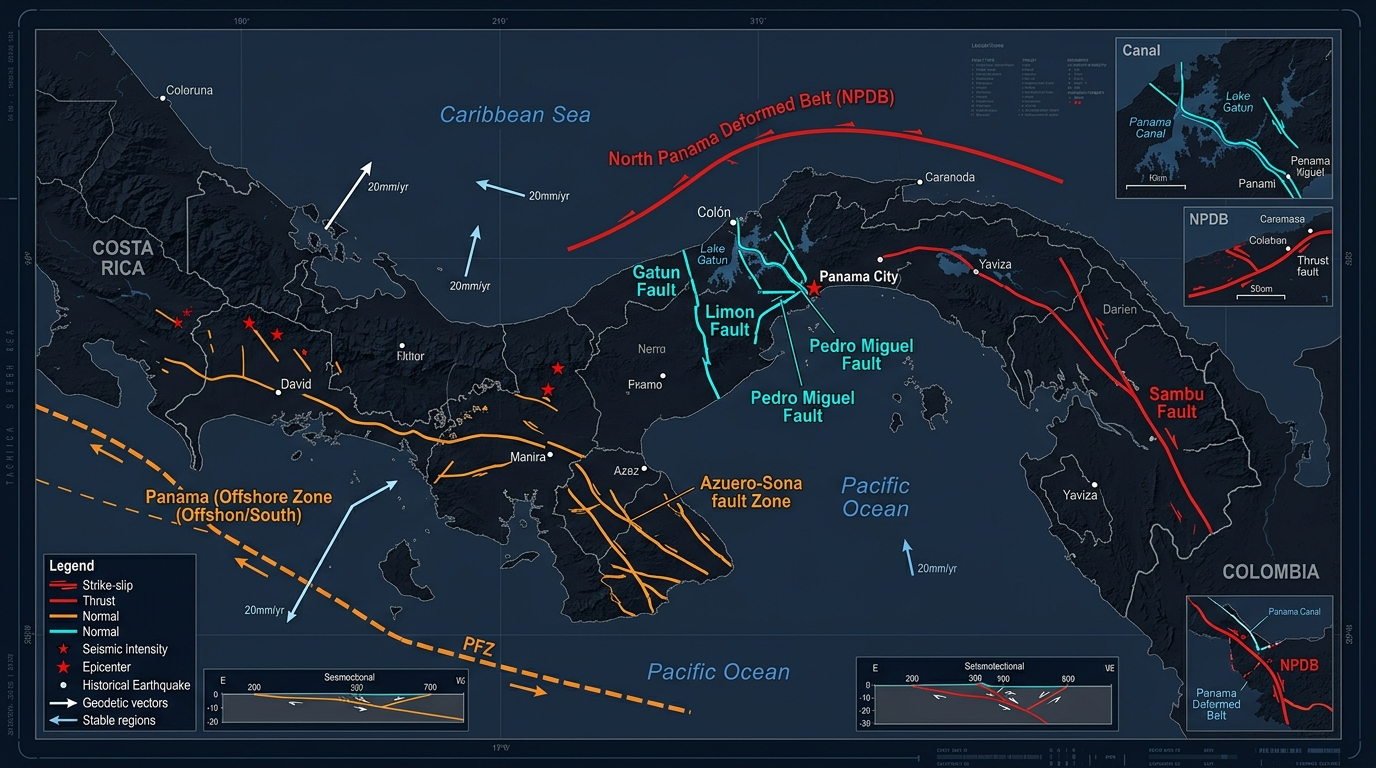
The Isthmus of Panama constitutes the Panama Microplate (Panama Block), squeezed between four major tectonic players: the Caribbean Plate (north), the Nazca Plate (south), the Cocos Plate (southwest), and the North Andean Block of South America (east).
Below is the technical hierarchy of the primary fault systems affecting Panama, ranked from highest immediate probability/urgency to lowest immediate rupture potential, combined with their human and logistical exposure.
2. Hierarchy of Seismic Fault Systems in Panama
1. Panama Fracture Zone (PFZ) & Southern Transform Fault (Western Pacific / Gulf of Chiriqui)
- Probability Level: CRITICAL / VERY HIGH (Immediate and Continuous)
- Structural Regime: Right-lateral strike-slip transform plate boundary separating the Cocos and Nazca plates.
- Deformation Rate: Extremely rapid, estimated at ~50 mm/year (5 cm/year)—the fastest kinematic boundary in Panama.
- Tectonic Behavior: Due to rapid plate motion, it does not require centuries to accumulate critical stress. It routinely produces moderate to strong earthquakes ($M_w\ 6.0\text{ to }7.0+$) every few years or decades.
- Historical Precedents: Puerto Armuelles earthquakes of December 25, 2003 ($M_w\ 6.5$), July 30, 2002 ($M_w\ 6.3$), the 1934 event ($M_w\ 7.6$), and ongoing oceanic swarm sequences.
- Technical Verdict: The most active, recurring, and persistent source of ground shaking in Panama, directly impacting Chiriqui, Bocas del Toro, and the Ngäbe-Buglé region.
2. North Panama Deformed Belt (NPDB – Central & Eastern Caribbean Segments)
- Probability Level: HIGH / PRIORITY (Mature Stage of Seismic Cycle)
- Structural Regime: Submarine fold-and-thrust belt accommodating north-south convergence of the Caribbean Plate against Panama.
- Deformation Rate: Moderate to slow (~10 to 20 mm/year).
- Maturity & Accumulated Deficit:
- The western segment ruptured on April 22, 1991 during the Bocas del Toro / Limon earthquake ($M_w\ 7.7$).
- In contrast, the central and eastern segments (offshore Colon, Costa Arriba, and the Guna Yala archipelago) have not experienced a major rupture since the devastating earthquake and tsunami of September 7, 1882 ($\sim M\ 7.9$).
- This segment has accumulated over 144 years of uninterrupted elastic strain.
- Associated Threat: Given its shallow submarine thrust geometry, this structure represents the country’s primary source for destructive near-field tsunamis, capable of impacting Caribbean shores within 15 to 30 minutes.
3. Pedro Miguel & Miraflores Faults (Metropolitan Corridor / Panama Canal Basin)
- Probability Level: HIGH TO MODERATE-HIGH (Highest Criticality Due to Urban & Economic Exposure)
- Structural Regime: Left-lateral strike-slip intraplate crustal faults cutting directly through the Panama Canal locks and metropolitan area.
- Deformation Rate: Slow but steady, paleoseismically constrained between 2 and 5 mm/year (Rockwell et al., 2010).
- Accumulated Slip Deficit:
- The last documented surface-rupturing earthquake was the May 2, 1621 Panama Viejo earthquake ($M_w\ 6.5 - 7.0$), which destroyed early colonial infrastructure.
- With over 405 years of major seismic silence, the accumulated slip deficit exceeds 1.5 to 2.0 meters.
- Technical Verdict: Although its recurrence intervals span centuries, the structure is in an advanced stage of its cycle. Located beneath Panama City, San Miguelito, Arraijan, and the Canal locks, it poses the highest catastrophic risk (Risk = Hazard × Vulnerability × Exposure) in Panama.
4. Limon & Gatun Faults (Trans-Isthmian Corridor / Central Colon)
- Probability Level: MODERATE-HIGH
- Structural Regime: Strike-slip trans-isthmian fault systems transferring strain between Lake Gatun and the Atlantic coast.
- Accumulated Deficit: Paleoseismic trench studies date the last major ground rupture between the late 17th century (post-1680) and mid-18th century.
- Behavior: Shares the kinematic regime of the Pedro Miguel fault. It has not experienced an $M_w\ge 6.5$ earthquake during the modern instrumental era.
5. Sambu Fault & Darien Deformed Belt (Eastern Panama)
- Probability Level: MODERATE
- Structural Regime: Complex strike-slip and transpressional fault zone associated with tectonic escape between the Panama Block and the North Andean Block.
- Precedents: Epicenter of the major September 7, 1883 earthquake ($M\sim 7.8$) in Darien / Gulf of Uraba.
- Behavior: Extensive rupture lengths capable of major shocks, but strain is distributed over diffuse fault segments with multi-century return intervals.
6. Azuero–Sona Fault System (Post-October 9, 2026 Earthquake Status)
- Probability Level: LOW FOR NEW MAINSHOCK | HIGH EXCLUSIVELY FOR AFTERSHOCKS
- Structural Regime: Strike-slip and crustal accommodation fault system in southwestern Panama.
- Current Mechanical Status:
- The October 9, 2026 megathrust ($M_w\ 7.7$) ruptured ~150 km of fault length with over 8 meters of co-seismic displacement, releasing centuries of accumulated elastic strain.
- Stress Shadow: In the central ruptured segment, tectonic stress dropped drastically. The likelihood of another destructive mainshock ($M_w \ge 7.0$) on this same fault segment is extremely low; its seismic cycle has reset to year zero.
- Expected Activity: Seismicity here will consist strictly of an aftershock sequence for weeks and months (some reaching magnitude $\ge 6.0$ on peripheral fault asperities), decaying according to Omori’s Law.
3. Comprehensive Seismic Hazard Matrix
| Tectonic Structure | Fault Type | Slip Rate | Last Major Event | Slip Deficit | Probability Level |
|---|---|---|---|---|---|
| 1. Panama Fracture Zone (PFZ) | Right-lateral Transform | ~50 mm/yr | Recurring (2002, 2003, 1934) | Rapid Recharge | CRITICAL (Continuous) |
| 2. Central Caribbean Belt (NPDB) | Submarine Thrust Belt | ~10-20 mm/yr | Sep 7, 1882 (M 7.9) | > 1.5 m (144 years) | HIGH (Mature Cycle) |
| 3. Pedro Miguel / Miraflores | Left-lateral Strike-slip | 2 - 5 mm/yr | May 2, 1621 (Mw 6.9) | > 1.5 - 2.0 m (405 yrs) | HIGH / MOD-HIGH |
| 4. Limon / Gatun Faults | Trans-isthmian Strike-slip | 1 - 3 mm/yr | ~1680 - 1750 (Paleoseismic) | > 0.8 - 1.2 m (~280 yrs) | MODERATE-HIGH |
| 5. Sambu / Darien Faults | Transpressional Escape | Variable / Diffuse | Sep 7, 1883 (M 7.8) | Recharging (143 years) | MODERATE |
| 6. Azuero–Sona Fault Zone | Crustal Strike-slip | 2 - 4 mm/yr | Oct 9, 2026 (Mw 7.7) | 0 m (Mechanically Unloaded) | LOW (Aftershocks Only) |
4. Key Takeaways for Community Resilience
- Western Pacific (Chiriqui): Constant tactical vigilance required. Highest frequency of perceptible events.
- Central Caribbean & Metropolitan Corridor: Greatest national mitigation priorities due to maturity of slip deficits and dense concentration of population and critical infrastructure (Panama Canal, ports, metro line).
- Azuero Peninsula: Transitioning from high mainshock hazard to aftershock management and resilient reconstruction.
«Preparedness does not predict the date of an earthquake; it builds resilience so its arrival does not become a catastrophe.»
CIPRO Panama • Community of Innovation, Preparedness and Radio Operations • 2026